
Prose
Demiurge
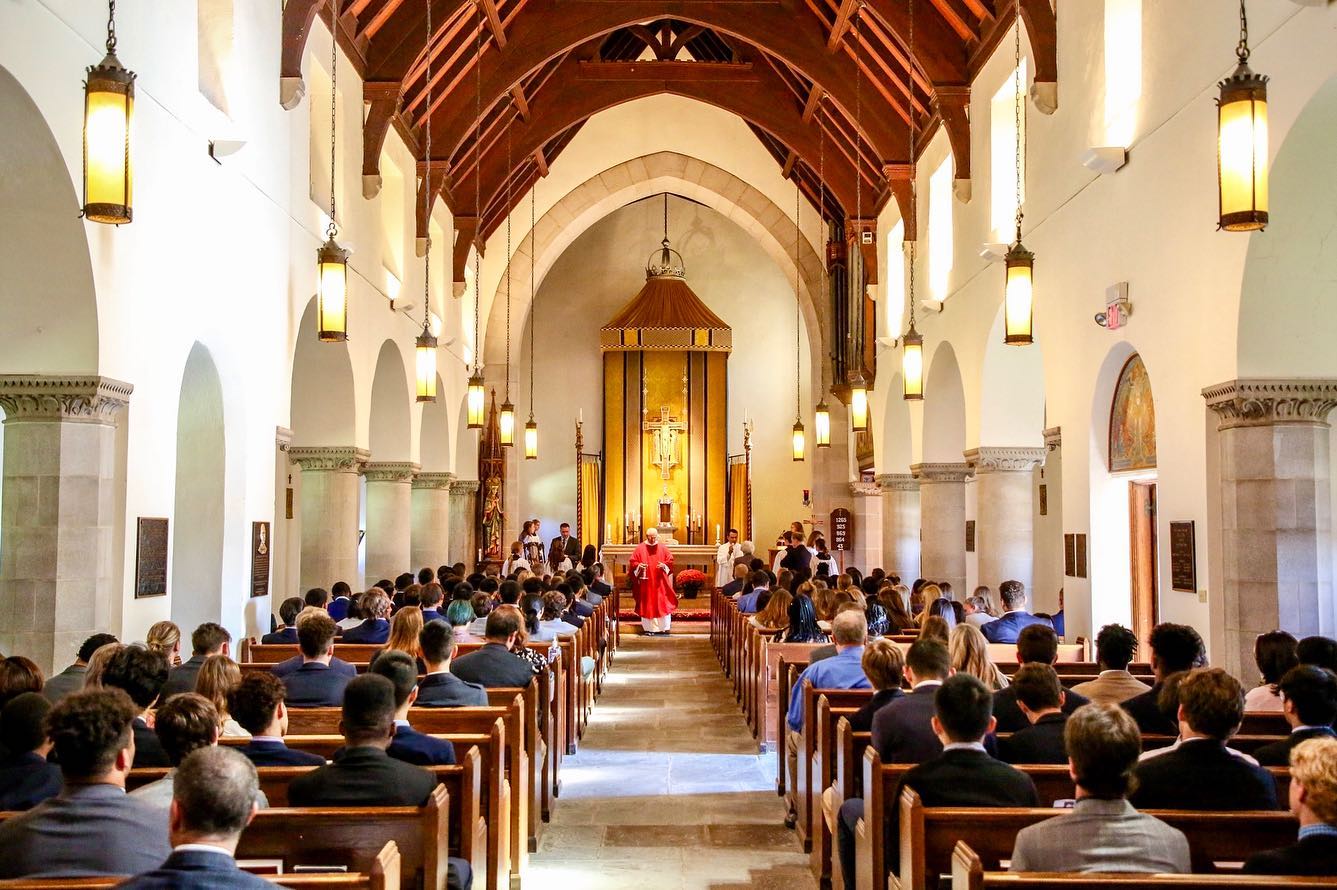
In the Winter and Spring Trimesters of my freshman year at Saint Joseph’s School for Boys, I looked out the window of my room in Morse Hall every night expecting to see a mushroom cloud. If you saw the mushroom you were already dead, but if the explosion was merely a faint reddish streak across the horizon, you had a chance of escaping with only severe radiation burns and the certainty of cancer. At least, that was what McHugh told me. McHugh also told me that the Soviets were going to nuke us just as soon as they increased the missile gap to the point of sixty to forty, that Jesus had killed a teenage boy in a lost book of the New Testament, that ancient philosophers had predicted any society with more obesity than malnourishment would annihilate itself in a spiral of decadence. That a god called the demiurge, who was in constant conflict with our own God, had created all that was evil in this world. McHugh lived one floor above me in Morse Hall, and in this period of six months he was my only friend.
I have flirted with religion on and off over the course of my life so far, tried Roman Catholicism, Protestantism, even Buddhism for a few months in college, but I have never felt closer to God—if He exists—than that time at Saint Joseph’s, although I knew so little of the world otherwise that it was possible for me to believe any woman with breasts smaller than a B cup was a lesbian, or that there was a possibility the school secretary, Ms. Berry, might sleep with me. (In this I was not alone. She was the only woman under fifty at Saint Joseph’s and thus a thousand or so boys considered her the closest thing to perfection they had ever seen, or at least could see while at Saint Joseph’s. Even the few Upper School boys who were rumored to have lost it with Pittsfield girls or on summer break spoke of Ms. Berry in hushed tones, with quiet reverence.)
Yet there were times when my pliable mind accepted McHugh’s teachings to such a great degree that I could feel the presence of his angry God like the darkness that blanketed Morse Hall after lights-out. He would sit in my desk chair while I lay in bed and spin elaborate visions of nuclear disaster, the Second Coming, the fall of the demiurge. He awaited these things impatiently. I would shut my eyes and listen as bright flashes appeared behind my eyelids. I anticipated at any moment the real Bright Flash. The one you could only ever see once. McHugh had assured me it would be beautiful.
I met McHugh after the first mass I ever attended at Saint Joseph’s. (It was always McHugh, never Neil. He once told me that God had intended first names for use only within families.) It was December then because I transferred to Saint Joseph’s late in the trimester. I had been expelled from yet another school, for essentially the same reason I had been expelled from all of them: frequent interruptions in class and poor grades.
Dropping my bags and I in front of Morse Hall, my father had said, “Remember, Jack, if you don’t stick it out here, our only option will be a military academy.”
That first week, the chance of me sticking it out at Saint Joseph’s had looked small. Father Banks, who taught English in addition to his role as assistant chaplain, had responded to my outbursts by saying I had a “voice like a fairy”. The Dean of Students, who had a more delicate manner, said that I was “adjusting poorly”. Or maybe he said I was “poorly adjusted”. Either way, he placed me on early curfew and revoked my dessert privileges at the dining hall.
So during my first mass in Cochran Chapel, when I took Communion, I shifted the wafer from my tongue to the inside of my cheek, and once I was back in my pew I let it fall in a drizzle of saliva onto my palm. Then I dropped it on the dusty wood floor. I don’t know why I did that. Certainly I had no intention of committing blasphemy. But it seemed like a small act of protest, one visible only to myself.
After mass, a boy drew up next to me in the line of blazer-clad boys marching to the dining hall. My first impression was that he was small, smaller than me, and I was small for my age. Red hair curled from the top of his head like tongues of flame, and he had a small, sharp nose.
“If you drop it on the ground they’ll find it eventually,” he said.
“What?”
“They call it a mortal sin. Defiling the Body of Christ. Not that anything can be a mortal sin in their false church of the demiurge.”
I stared at him without understanding. He glanced around us, then lowered his voice. “The Communion wafer. You didn’t eat it.”
“Oh. I could get in trouble for that?”
He raked his slender fingers through his hair. “I in malam crucem. Nevermind.”
Before I could formulate a response, he had already walked ahead in line, leaving me behind, his red hair disappearing into a river of brown, black, and khaki.
Perhaps most fifteen-year-old boys would have shrugged off such an encounter, forgetting it within the hour. But I had been at Saint Joseph’s a week and was already intensely lonely. Every group seemed to have solidified before I arrived, and, besides, what did I have to offer them? I was neither particularly athletic nor particularly smart nor particularly funny. My early curfew didn’t help either. Because of it, I had spent the past few evenings sitting in my room, daydreaming about circumstances that might bring Ms. Berry and I together. Maybe she would proctor one of my detentions. Or maybe she and I would find ourselves trapped together in the basement of the Commons after a nuclear attack.
I resolved not to let this chance at a friend pass me by. The strangeness of the red-haired boy encouraged me. Maybe he didn’t have many friends. Maybe there was nobody for me to compete with and be judged deficient to.
“What do you want?” he asked, not looking up from his food, when I sat down across from him in the dining hall.
“What’s your name?”
“McHugh.”
“McHugh?”
He looked up. His eyes were steely grey points. There was something in them that made them look like the eyes of someone much older, a wizened old priest, maybe, or a career politician. “Neil McHugh. I hope that satisfies your curiosity.”
“I’m Jack. Good to meet you.”
There was a long silence in which I cast about, like a man fumbling in the dark, for something to say.
“I want to know what’s so bad about not eating the wafer.”
He scoffed. “Oh, Christus. You haven’t been a student here for long. And you’re not a Catholic, are you?”
I thought for a moment. My family was the kind that only went to mass on Christmas and Easter. “No.” “Didn’t think so. You just desecrated the real body of Christ. You left God lying there on the floor of Cochran Chapel. In the Middle Ages, the Church burned host desecrators alive. They set a whole city ablaze at Beelitz in 1243. But if you get caught at Saint Joseph’s, they’ll settle for expulsion.”
He said that last word, ‘expulsion’, with a harsh tone that instantly transported me back to the offices of Principals and Headmasters and Deans of Students, to tearful conversations with my mother, to screaming matches with my father. I was always in trouble, and yet I never wanted to be anything other than a good student, to make my parents proud and happy.
But in class I could not keep myself quiet, the way so many others did. I fidgeted, looked out the window, and tried to start side conversations with boys who never even wanted to talk to me in the first place. The lack of their approval only made me seek it more, and soon, inevitably, I found myself talking constantly, interrupting the teacher, making feeble attempts at jokes. Being a bad kid seemed like my natural state. And here was another piece of evidence—I had only been at Saint Joseph’s a week and had already committed a sin so bad the church once burned people for it. The military academy seemed certain. I could already see the glinting metal fence and hear the screaming drill instructor.
“Well, of course, not everyone believes that the Eucharist still transubstantiates in this era of the Church. I don’t, for one.”
I was jolted back into the present moment, mostly by sheer confusion. “What?”
“I mean that in order to transubstantiate a priest must be validly ordained, and a church that censored the books of the Nag Hammadi Library in the twelfth century is not capable of valid ordination. In the modern church the wafer remains just a wafer, and it is impossible to sin against a wafer.”
“So I didn’t do anything wrong?”
“Not in God’s eyes. In fact, in His view I would imagine you did the only correct thing, given the circumstances. Congratulations, you’ve differentiated yourself from Saint Joseph’s very own horde of demiurge-worshipping heretics.”
It was not his words, which I didn’t understand, that gave me a rush of relief, but his usage of the phrase you did the only correct thing. I must have smiled, or something, because suddenly he grinned. It seemed like an uncommon expression for him, judging by the way the corners of his mouth creased unevenly.
“Of course, that won’t stop one of our fat priests from expelling you straightaway if he finds you. They’ve been on a special lookout for host desecration recently. Lots of worries about Black Masses with all those anti-war demonstrations in the city, although the Saint Joseph’s idea of a hippie is a boy whose crew cut has grown out past his ears.”
I laughed.
“I don’t eat the false Body either,” he said. “But I rub it to crumbs on my pants to destroy the evidence. May I ask”—he leaned forward, as if he was inspecting a specimen in a museum case—“why don’t you eat it?”
I didn’t have an answer for him then, other than that I hated Saint Joseph’s. On this common ground we became friends. It was a strange friendship. I saw little of him; he never took part in games on the quad and he had all of his lessons alone, private tutoring sessions with the Upper School teachers. The other students believe him to be some kind of child prodigy, passing a few years at Saint Joseph’s before setting off to some Ivy where his mind would work wonders ordinary people like us could not even conceive of. This, of course, made him someone to shun and exclude at every opportunity.
Not that McHugh minded his exclusion. I never saw him talking to anyone except me; he deliberately avoided other students. The fact that we were each other’s only friends seemed to me a great bond. We only talked in the evenings, always in my room: long, feverish discussions in which he spoke and I listened. He would tell stories, long stories that he had memorized from the Bible and other ancient books, stories that disturbed and enraptured me. They involved prophets murdering disrespectful children or having sex with their daughters. They were the kind of thing I could not imagine our Catechism teacher, greying old Mr. Hunter, ever telling us about.
He also gave impromptu philosophy lectures, which touched on everything from early Roman history to the behavior of monkeys kept in captivity, but always returned to the same central point—destruction was coming soon. Destruction of the nuclear variety. McHugh held that Kennedy had lied about saving us from the Cuban missiles. Johnson was continuing this lie, as well as lying about the missile gap, which was in fact much greater, not lesser, than our parents had once believed.
All of it was because of a false god called the demiurge. The demiurge created all that was evil in this world, just as God created all that was good. The demiurge manipulated global events to increase lies and suffering. It endeavored to conceal its own existence, so that its works might be confused for those of God, and had long ago gained control of the Catholic church. Its servants had suppressed the books of the Bible that revealed its existence.
McHugh knew this because in 1945 some of the suppressed books had been found in Egypt. He read them in their entirety, on microfilm copy, while at Yale for a summer program. Realizing that he had discovered the essential truth of the world, he made hasty reproductions in several notebooks and brought them back to Saint Joseph’s.
Anyone with half a brain, he said, would deduce from these books that nuclear war was God’s way of wiping out all of the works of the demiurge. The demiurge had so totally corrupted our world that God would rather destroy it than see it further twisted. From the ashes of the old a new world would be born. God would improve on His own creation, as He had done in the time of Noah.
At first I did not know what to make of McHugh’s ideas, beyond the fact that they were a good way to pass the lonely violet hours of my early curfew. But over time they started to gain a hold on me. I remember one night he abruptly stopped in the middle of a discourse on Arabs and Berbers.
“What is it, McHugh?”
“Oh, nihil. It’s just that I can tell you still don’t believe, Jack. You cannot bring yourself to believe in dualism, to believe that the things you see in this world are the work of its hands as well as God’s.”
“I believe that the church is stupid, like you said. And I hate Saint Joseph’s.”
“Sine omnia bullshita.” That was one of McHugh’s favorite expressions, a bastardized Latin phrase he used to convey anything from minor annoyance to the deep demiurgical rottenness at the center of the world. Bullshita meant lies, confusion, the tools of the demiurge.
“Look,” he said, “let me give you an example that may hit closer to home. Think of—Father Banks. That old ignorant pig who doesn’t teach anything more recent than John Bunyan, with that face like a Doberman Pinscher. Who abuses you constantly. Who calls you—what is it?—a ‘fairy’.
“Did God create him? Did God design him, specifically, to spread his ignorance and make you suffer? You can make arguments about free will, but you have to concede that a man like Father Banks need not exist. The fact that he does is proof that there’s another designer at work. The demiurge.”
Out the window, the dark line of the Berkshire Mountains formed a base for the red ball of the setting sun. The spire of the Cochran Chapel, resting on the hill above us, was a jagged pillar of shadow. Students flitted across the quadrangle like negatives of a blurry photo. And I felt the darkness surrounding us, pressing in on us from all sides, and my room felt like a raft in the middle of a roiling black sea.
“Now do you see?”
I did.
Thus McHugh converted me into his religion. I did my best to internalize his teachings, and I began to see things in a new light: the burly jocks who bumped me intentionally in the hallways, the frequent trips I made to the Dean of Students’ office, the single, page-long letter I had received from my parents in a month and a half. The fact that Ms. Berry did not seem to know I existed. All were creations of the demiurge.
I began each night to look for the Soviet nuclear bombs or missiles with which, McHugh said, God would wipe away this corrupted world and start again. A second Flood.
Although I believed in the coming apocalypse, I don’t know if I ever really believed that I, personally, would die. That would have required me to understand that the world could go on existing without me, an understanding I believe few fifteen-year-old boys could have mustered. But I understood that the world could die. It could sink into oblivion in the same way it did when I went to sleep every night, except permanently. And there was a strange thrill in imagining it. No more Father Banks. No more Dean of Students. No more—on bad nights, I even permitted myself the thought—father and mother.
“One bright flash,” McHugh would whisper, late in the evening. “No pain, if we’re lucky enough to be within five miles of a hypocenter. Then, nothing. The demiurge is banished back to its abyssal pit of darkness. Sine omnia bullshita.”
Throughout the Winter Trimester, Father Banks was no more than one bully in a succession I dealt with every day, teachers and students alike, but in the beginning of spring Father McCleary went on spiritual retreat and Father Banks became interim chaplain, which meant he gave the homilies at mass. It was then that he became the focal point of my loathing and McHugh’s fury.
I remember him standing there, behind the pulpit, during the first mass he officiated. He was a fat man, but comfortably fat, fat in the way where you felt like it was how God had intended his body to be. He had short black hair that he slicked back over his round head, and he spoke with a mellifluous bass, accentuated by a slight Southern twang.
“Well, boys, one thing about me is I hate to beat around the bush,” he said. “My mother used to tell me, ‘Leonard, say what’s on everyone’s mind and don’t mind what anyone says’. So that’s what I’m gonna do.
“You’re worried about all of the conflict in the world today. About the upheaval in Asia. I’ll put it even more direct: you’re worried about Communism.”
It was the first time I had ever heard anyone say the word ‘Communism’ in Cochran Chapel. I looked over at McHugh. His head had snapped up.
“I tell you, you’re right to be worried. These people have sworn themselves enemies of the church. Which makes them enemies of the American way of life. Enemies of all of you.”
He had rolled up the sleeves of his silky white alb, exposing hairy workingman’s forearms, as if at any moment he expected a Communist to present himself for a good old-fashioned ass-whupping.
“What we need now is to come together under one banner, one flag. Faith in God and in His church.”
He leaned forward, and the pulpit creaked under his weight.
“We’ve been hearing reports of subversive conversations among the students. Of anti-Catholic, anti-American practices. I will tell you that this must end now. As your new chaplain, I’ll tell you flat out—enemies of the church have no place at Saint Joseph’s.”
McHugh’s knuckles went white around his hymnbook.
“Now,” Father Banks said, “let’s talk about today’s Gospel.”
That night, McHugh delivered a long exegesis on why Father Banks was an idiot, stringing together observations about Southern culture, John Bunyan, and bodily hygiene. He made me laugh several times. (He could be quite funny when he was impassioned, although he didn’t recognize this humor himself—his consummate seriousness created it.)
At the end of his speech, he stared for a long time at the flat blankness of my wall.
“He’s right about one thing, though.”
“What’s that?”
“He is a servant of the demiurge. We are servants of God. Therefore, we are his enemies.”
“Sure,” I said quickly. Although my trips to the Dean of Students’s office had fallen from once every few days to once every few weeks since I had met McHugh, I was still on thin ice at Saint Joseph’s. Talk that implied getting in trouble made me nervous.
“Really,” he said. “Sine omnia bullshita, we are his enemies. You believe that he is a servant of the demiurge, right?”
Whenever I did or said anything that evinced doubt in his teachings, McHugh would become aloof, stay away from my room for days, sentence me to long quiet nights with nothing to keep me company but my Pilgrim’s Progress and my Wheelock’s Latin. And it was late, and I did not want to try sleeping with both the impending nuclear holocaust and the potential loss of my only friend on my mind.
“Of course I do.”
“You’re with me on this one. Right, Jack?”
I did not know what he meant by on this one, but I wasn’t sure I wanted to. “I am.”
That night, as I slipped into an uneasy sleep, McHugh was still sitting in my desk chair. His shadowy form expanded and contracted with steady breaths, lost in an indescribable inner world to which—I realize now—I could never accompany him.
Although Father Banks’s angry homilies continued, McHugh and I seldom spoke of them. I could tell it would be a source of tension, and McHugh, I suppose, had reasons of his own for not bringing him up, although occasionally he would let slip some strange detail. For example: “Did you know Father Banks’s car is never in the faculty lot on Tuesday or Thursday nights?” or “Did you know Father Banks holds a degree from Ozark Bible College?”
I never knew what to say to these observations. They told me that McHugh was gathering information on Father Banks in some way, but I was afraid to ask him about it directly. The knowledge could only lead to deeper involvement.
As the months rolled on, his stories grew even darker. I remember one night, he told a story about how teenage Jesus had killed a child in Nazareth for running into him and knocking him over. (“Jesus said, ‘You will not continue your journey’,” McHugh said, voice rising high and operatic, “and the boy fell down and died.”) Then Joseph tried to discipline Jesus by pulling on his ear, but Jesus stopped him, saying “Don’t you know that I don’t really belong to you? Don’t make me upset.” McHugh told that part with special care, describing how the air had seemed to crackle with energy, how Joseph had drawn back, eyes wide, how Jesus’s voice had suddenly not seemed like the voice of a child, not the voice of a human at all. The story ended with Jesus raising the child from the dead. Covered in dirt and wooden splinters, the resurrected corpse immediately knelt and bowed down.
I slept badly that night.
The night after that story, McHugh said he had something to show me.
“Put on your shoes,” he said. “We’re going out.”
“Out? How?” It was hours past both my curfew and regular curfew. The campus was so dark that my window appeared to have been covered by black velvet.
“I’ll show you.”
“McHugh, I mean, you know I’m on behavioral probation…”
“We won’t get caught. Sine omnia bullshita.”
“But—”
“Compared to fighting the demiurge, your own fears about”—he lowered his voice with distaste—“behavioral probation should mean nothing to you. That is, if you actually believe.”
I pretended to consider it for a few seconds, engaging in a mock struggle with myself just to maintain my dignity, but in truth I had already made my decision.
The way out turned out to be a window in the dark common room at the end of the hallway. McHugh had found a way to jiggle it so that the iron latch on top slipped, and then we only needed to open the window slowly, so that it would not creak and alert the sleeping Resident Head. McHugh made me slide out first. I scraped my chest against the rough brick exterior before I dropped into one of the crouching azalea bushes that ringed Morse Hall. McHugh landed behind me.
“Nobody’s supposed to be awake right now except Mr. Waters,” McHugh whispered, “and that old drunk’s probably asleep in the security booth. Follow me.”
The quadrangle at Saint Joseph’s was on an incline, a hill which swelled up to the Cochran Chapel on its crux. (“Like the whitehead of a pimple,” McHugh once said.) He led me up it that night, but we passed the silent spire of the Chapel and kept walking.
He led me around to the back of the building, where a short driveway connected the main road to a loading dock. He jerked his head at a line of slanted oaks that leered out over the road.
“Over there.”
We crouched on a bed of dried twigs behind the trees. The driveway was a pit of shadow.
“Now we wait. Stay quiet.”
After a while, I heard the grinding noise of tires on gravel. It was an unusual sound for the road to Saint Joseph’s, which was deserted as a rule except on move-in and move-out day. Then a red sweep of headlights came around a bend, fragmented by the trees and casting spiderlike shadows on the storage facility. Our own shadows were captured in the spotlight glare, although they would have been unrecognizable to anyone else: little black lumps like bushes or tree stumps or another inhuman shape.
A Lincoln Continental, chrome grill turned milky white by the moonlight, stopped in the driveway. It was a car I recognized. Only one faculty member owned such a flashy automobile: Father Banks. The dome light was on, and the bright inside of the car stood out like a television in a dark room. Father Banks was driving, in the black monastic habit he wore when he wasn’t officiating mass. Next to him, sitting in the front passenger seat, was Ms. Berry. I watched the woman I and almost every other boy at Saint Joseph’s had fantasized about lean over and kiss Father Banks on the mouth. Her white fingers were small and stark on his black habit. He cupped his hands around her breasts. I felt a sudden anger, as well as a deep and painful spike of arousal.
By the time I noticed that McHugh had taken out a camera, he had already pressed his eye against the viewfinder. I heard his voice over the sharp clicks of the shutter. “I in malam crucem. In malam crucem, scurra. You’ll soon be crucified.”
She pulled back after a while and cast furtive glances into the darkness. Father Banks said something that made her laugh. Then she got out of the car, stretching out her arm to prolong their contact until the last possible moment. She walked down the hill towards Baxter Hall, where most of the junior faculty lived. Father Banks drove his Continental off into the night.
On the way back to Morse Hall, McHugh barely bothered to lower his voice. “Of course, I could have gotten the pictures by myself. But I wanted you to see their debasement, those servants of the demiurge. I wanted you to see it firsthand, not just in pictures. Weren’t they disgusting?”
“What do you think Ms. Berry sees in Father Banks?” I asked glumly.
“Power? Status? Maybe she likes his fat face. Does it matter?”
“I just didn’t think Ms. Berry would like someone like him.”
McHugh didn’t say anything. He did not share my and the rest of the school’s fixation with Ms. Berry. To him, the physical passions were bullshita, demiurgical, false and disgusting. Often, when he told me about nuclear attacks, he emphasized their cleanliness: bodies turned to ash and shadow in Hiroshima, no blood or bones or fluid, no need to deal with any of the messy remains of human functions.
As the shape of Morse Hall became clear and defined below us, he sang out: “Soon all of the demiurge’s works will be destroyed. But first, I’m going to humiliate two of its servants, just to show everyone who they’re following. Just so everyone sees. Sine omnia bullshita.”
The clouds were tears in the black fabric of the sky, and I wondered if God and the Soviets would choose tonight to finally annihilate us.
But the world remained existent, and McHugh got his film developed at a store in Pittsfield. The next day, during our free period, he enlisted me to help post the photos around campus. Looking back, of course I was hurting Ms. Berry, and I must have known it then, but maybe I told myself that sacrifices were required to destroy the demiurge.
“I suppose you believe that because we are servants of God, we can’t hurt anybody,” McHugh had said.
I protested. Wasn’t God merciful?
“To those who deserve it, maybe.”
We split up to reduce the chance of getting caught. As instructed by McHugh, I taped my first photo to the screen of the television in the common room of Peabody Hall. I put the second one on the inside of a bathroom stall in the Bulfinch Gymnasium. I tried not to look at the photos as I put them up. Every time I caught a glimpse of Ms. Berry’s hair falling messily over her shoulders, the pale flush of her cheeks, I felt jealous. Even knowing what she’d done with Banks—or perhaps all the moreso because of it—I desired her.
Then I trudged across the sunny quadrangle to the “Student Activities” corkboard in Phillips Hall, which McHugh had selected as my final destination. I had walked the path to Phillips many times before. The school’s front office was there, and the Dean of Students had a connected office in the back corner, next to the teacher mailboxes.
Getting sent out of class always had one silver lining. While I waited for the Dean of Students to call me in, I got to stare at Ms. Berry, sitting at her desk and percussing musically on her typewriter. Sometimes she would chew on the end of her pen, holding it like a cigarette between her slender fingers, and in those moments I thought she looked like Lauren Bacall in The Big Sleep. She had the same mousy brunette hair, smoky eyes, and sharp eyebrows.
I would sit there and wait for her to say something, to acknowledge the connection between us, to hug me against her breasts and kiss me and say that everything would be alright. That she knew I wasn’t a bad kid. I never tried to do anything wrong. But now that I knew about her and Banks, I could not imagine her this way—only naked and in my arms.
I walked up the steps of Phillips Hall, through the door, and stood in front of the corkboard. An empty brown patch between the flyers bared itself, inviting me. But I thought of Ms. Berry coming out of the front office and seeing it, and I couldn’t put the final photo up. Not yet. Instead, I went down the hall.
There she was: sitting at her desk, leafing through a spiral-bound directory. My eyes were drawn to the swell of her breasts underneath her blouse. Eventually she looked up at me.
“Can I help you, young man?”
No, you can’t, I wanted to say. Once you could have, but you had to go and ruin it.
She squinted, then she snapped her book shut. “Oh, it’s you. Not again.”
“What?”
“You know what I’m talking about. You’re always getting sent to see the Dean. Why can’t you stay out of trouble.”
“You remember me?”
“Of course I do.” She smiled, and for a moment all my anger disappeared. “Just because I’m sitting here behind this typewriter doesn’t mean I’m blind.”
I wanted to make excuses, something to let her know I wasn’t as bad as my office visits had suggested, but I wasn’t sure what those were, or if they would be true. Maybe I was bad. I opened my mouth but she already knew what I was going to say.
“Young man, when you get a little older, you’ll realize that the whole world isn’t out to get you.”
McHugh would have had a good comeback for that one, something—more artfully put, of course—about the demiurge being a literal god that was, in fact, out to get us. But I wasn’t McHugh, and all I could muster was: “You don’t understand.”
She pursed her perfect lips. “Okay, fine. But one of these days you’re gonna wake up, and you’re gonna think to yourself”—she widened her eyes and dropped her mouth into a small round o, an expression that immediately filled me with compulsive desire—“‘Oh God, the world isn’t out to get me. Ms. Berry was right.’”
My need for her swelled alongside an awareness of its futility. I could never have her. She would never understand me.
“Anyway. The Dean’s in a meeting right now. Would you take a seat?”
“Actually, I’m not in trouble. I just have a free period right now.”
“Oh. Well—good.” She smiled at me for the last time. “Go be free then.”
I lingered by the door, taking in the image of her sitting at her desk, fixing it in my mind, trying to absorb every color, every curve. She had reopened the directory, and the glare of the afternoon sun through the window was turning her hair to honey gold. I was so full of attraction I thought I would explode like a nuclear bomb. Then I saw Banks’s greedy hands on her, defiling her, and I walked down the hall and pinned the last photo on the corkboard.
That night, McHugh and I ate together at the dining hall. On my way back from the kitchen, I passed a loud group of students huddled around a table. They hung their heads together then threw them back in manic laughter. I knew what they were talking about, and I stopped to listen.
Someone expressed surprise that Father Banks had it in him, especially considering his size. (“No, I got an uncle like that. Don’t even know if he can see it, but he sticks it into anything that moves.”) Most of the talk, however, focused on Ms. Berry. They way her breasts could be seen through her unbuttoned collar. The way she blushed when he kissed her. (“She looked like she was enjoying it,” one awestruck voice said.) They speculated about whether she had given it up, and consensus was that she had. In some ways, they spoke like we had all spoken about her before, and yet it was different, too. The quiet reverence had been replaced by something louder and uglier.
I returned to the isolated corner table where I sat with McHugh. He was leaning his small frame back in his chair, pointing his chin up in pleasure.
“Everybody’s talking about Ms. Berry,” I told him.
“What?”
“They’re barely saying anything about Father Banks at all. They’re just talking about Ms. Berry spreading her legs.”
He held an apple, one of the black-spotted, mushy ones they fed us at Saint Joseph’s, and turned it around and around in his hands like a precious stone. “Any woman who works at a boys school likely harbors some nymphomaniac tendencies. I doubt Banks is her first.”
I stared at my indistinct reflection in the wooden tabletop, which shone yellow from years of accumulated grease.
“You know what Ms. Berry told me?”
He cut the apple into chunks with his fork and knife, speared several of them, and chewed them methodically before swallowing.
“‘The world isn’t out to get you.’ That’s what she told me.”
“Oh,” he said in flat monotone. “Very interesting.”
Sitting there in his position of comfortable repose, holding his fork in his fist like a scepter, he looked like a faded photo of an ancient Roman bronze, one I had seen in my Latin textbook, a young conqueror leaning back on his throne. I had the sudden image of myself as a supplicant, falling at his feet.
“But she’s wrong. Right, McHugh?”
“‘The world isn’t out to get you’? Do I really have to answer that? After everything I told you, are you really dense enough that I need to explain why she’s wrong? Sine omnia bullshita?”
I heard an echo in his voice of the Dean of Students, Father Banks, my father, now Ms. Berry—the many adults in my life who implied or said outright that something was wrong with me. McHugh’s eyes were as cold and empty as if they had been made of stone. I replayed the events of the winter and spring I had spent at Saint Joseph’s, a period of time that seemed totally defined by my relationship with McHugh. I had spent countless hours—unable to fall asleep, unable to focus in class—worrying about the demiurge and the imminent nuclear holocaust. All because of McHugh. But I suddenly realized that McHugh did not care about what I wanted or about me. I had been in the right place at the right time to receive his gospel. The day we met, sitting in the same place we sat now, I might have been anybody. McHugh did not want a friend. What he wanted—what I was—was a disciple.
McHugh continued to spear the cut-up pieces of apple with his fork. I laughed hopelessly.
“What?” McHugh’s face was shrunken and pinched by annoyance. “What’s so funny?”
“Nothing.” But I couldn’t stop. It was the way I got in class sometimes, when Father Banks told me to wipe that damn smirk off my face: desperate, doomed, uncontrollable laughter.
“Jack, do you know that laughing like that is one of your most distasteful habits? We’re waging war against the demiurge. The maker of all evil. I wish you’d be a little bit more serious about it.”
The next day, all of the photos were gone: taken down by students or faculty, we never learned. But everyone had seen them or at least claimed to. In the ensuing months, you would hear rumors: so-and-so has the photos in his room. He keeps them behind his dresser or in his pillowcase. He won’t share them, the goddamn greedy bastard.
The administration never acknowledged it, at least not to students. But the next time I was sent to the front office, Ms. Berry was gone. Her typewriter wasn’t on her desk. When I walked by Baxter Hall, her window curtains were drawn. I told McHugh and he shrugged.
“None of the servants of the demiurge will be able to run for much longer.”
I never saw her again, at least not in the flesh. She remained a regular topic of conversation at Saint Joseph’s for as long as I was there, and for long afterwards, I’m sure. Even decades later, boys who never saw her probably hear about how she had sex with Father Banks right on the altar, how they shared the consecrated Host after. But nobody seemed interested in what had become of her. The isolation of Saint Joseph’s was such that, when someone left, it was as if they ceased to exist. People were remembered only as they were; nobody ever wondered aloud how so-and-so was doing at Andover or Trinity or wherever they’d gone. This comforted me, as I began to anticipate being asked to leave at the end of the semester. But, then again, I had already been invisible to everyone, including McHugh, while I was there.
Father Banks, on the other hand, stayed on for the rest of the year. In fact, after the incident his popularity with the students grew immensely. He even got a standing ovation during the next mass. Applause thundered through the nave, mixed in with scattered whistles and low cheers. Abbot James yelled at us to quiet down, threatening collective loss of dessert, but not before Father Banks stepped away from the pulpit and took a bow. Maybe part of him hoped they were applauding because of the oblique reference to Castro he had managed to work into his homily. But no—he knew the real reason. I can still picture the way he grinned at us, a smile full of secret knowledge and surreptitious joy.
Part of me wanted to turn to McHugh, sitting next to me in the pew, and ask why—if we were acting as agents of God—this reality seemed so much like it had been created by the demiurge. Had we been tricked, too, just like everyone else? Or was it McHugh that had tricked me? I didn’t say anything. I knew he would just get angry, call me stupid. Even as we sat next to each other, I was already mourning the loss of someone I had believed to be my only friend.
After mass that day, I told McHugh I was feeling sick and wanted to be alone. I skipped dinner and walked directly across the quadrangle to Morse Hall, stepping absentmindedly through a frisbee game on the way. (“Hey, are you blind, kid?” an Upper Schooler called after me. “Leave him alone,” another said. “That fairy looks like he’s about to cry.”) I went back to my room, shut the door, locked it, and lay down. Tonight would be the night the bombs fell. I just knew it. I lay there, staring at the nonsensical shadows that filtered through my blinds, and waited for the Bright Flash. I hoped I would be within five miles of a hypocenter.
I woke up hours later and saw blood-red light on my wall. I rushed—hopefully, I think—to the window. For a moment, the fiery orb in the sky deceived me, and I felt frozen, detached, absolved. This is it, I thought. But a moment later I realized it was only the sun.
Daniel Sipes is originally from Washington, DC. He currently studies creative writing at the University of Chicago. He spends most of his free time reading.